
Mythos Came Down From the Mountain.
Here's What L&D Should Do With Fable 5. 🦋

☕ 11- minute read
For Instructional Designers, Learning Managers, and L&D Operations
For about three months, the AI corner of my feed has been chewing on a rumor named Mythos. The model Anthropic built but wouldn’t hand over. The one they gave to cyber defenders and government partners, while the rest of us watched from outside the glass. The people who’d touched it talked about it the way you’d talk about a car you’re not allowed to drive. It supposedly found thousands of high-severity vulnerabilities across every major operating system and browser. We all filed it under “someday.”
Today, the safe version of it showed up somewhere that any of us can reach it.
Anthropic released Claude Fable 5, and they’re blunt about what it is: “a Mythos-class model that we’ve made safe for general use.” Same underlying brain as Mythos, wrapped in guardrails so the rest of us can touch it. The locked sibling, Claude Mythos 5, stays with a small group of security and biology partners who get the guardrails lifted. So the thing we’ve been whispering about is here, sitting in the model picker next to Sonnet and Opus.
Now before any of us point it at our next curriculum build, we should be honest about three things: what it’s good at, what it’s wrong for, and what it costs. That last one has two deadlines attached, and they’re both this month.
TL;DR
🚀 Fable 5 is the public, safeguarded version of Mythos, and Anthropic calls it the most capable model they’ve ever released to everyone. Its lead grows the longer and messier the task. Stripe reported it ran a codebase migration in a day that would’ve taken a team two months by hand (a vendor number, so hold it loosely).
💸 It costs $10 per million input tokens and $50 per million output tokens. That’s double Opus 4.8 and more than triple Sonnet 4.6. On Pro, Max, and Team plans it’s free only through June 22. Starting June 23 it pulls from paid usage credits.
📅 Separately, on June 15 Anthropic splits automated agent usage off subscriptions. If you work in chat, Cowork, or the Claude Code terminal, this one doesn’t touch you. I’ll show you exactly where the line falls.
What Fable 5 is, in plain terms 🧠
Anthropic stacks its models in tiers. Sonnet for everyday balance, Opus for harder reasoning, and now a tier above Opus, they call Mythos-class. Fable 5 sits at the top, made safe enough to ship to everyone.
The jump is real, and it’s specific. Fable 5 is built to hold a long, complicated job together without losing the thread. The longer the task, the further ahead it pulls from the other models. Anthropic showed it could rebuild a working app’s source code from screenshots alone, stay focused across millions of tokens, and improve its own output by leaving notes for itself as it worked. The Stripe story is the one making rounds (months of migration compressed into a day), and I’d read it the way I read every vendor benchmark: the structural claim is probably true, the exact number was picked because it sounds good in a launch post.
Here’s the part that matters for us. The work where Fable 5 pulls furthest ahead, the long and tangled stuff, is the exact work we keep avoiding because it’s too big to start on a Tuesday afternoon.
⚠️ The catch nobody’s putting in the headline
There’s a trapdoor built into Fable 5. Because it’s so strong at things like cybersecurity and lab biology, Anthropic added classifiers that quietly hand certain questions off to Opus 4.8 instead. Ask Fable 5 something that trips the cyber, bio, chemistry, or model-copying wires, and you get an Opus answer with a note telling you the swap happened.
They tuned those guards on the cautious side, so they’ll sometimes catch harmless requests. Anthropic’s own data says fewer than 5% of sessions hit a fallback at all. For more than 95% of what we do, we’re talking straight to Fable 5. Still, knowing the floor can shift under one specific kind of question is the sort of thing I’d rather hear now than discover mid-project.
One more line worth flagging for anyone in a regulated shop: Mythos-class traffic carries a mandatory 30-day data retention window on both first- and third-party surfaces. Anthropic says it won’t train on that data and will delete it after 30 days. If your security team has rules about what leaves the building, have that conversation before you pipe anything sensitive through Fable 5.
🔑 Who actually has this, and who doesn’t
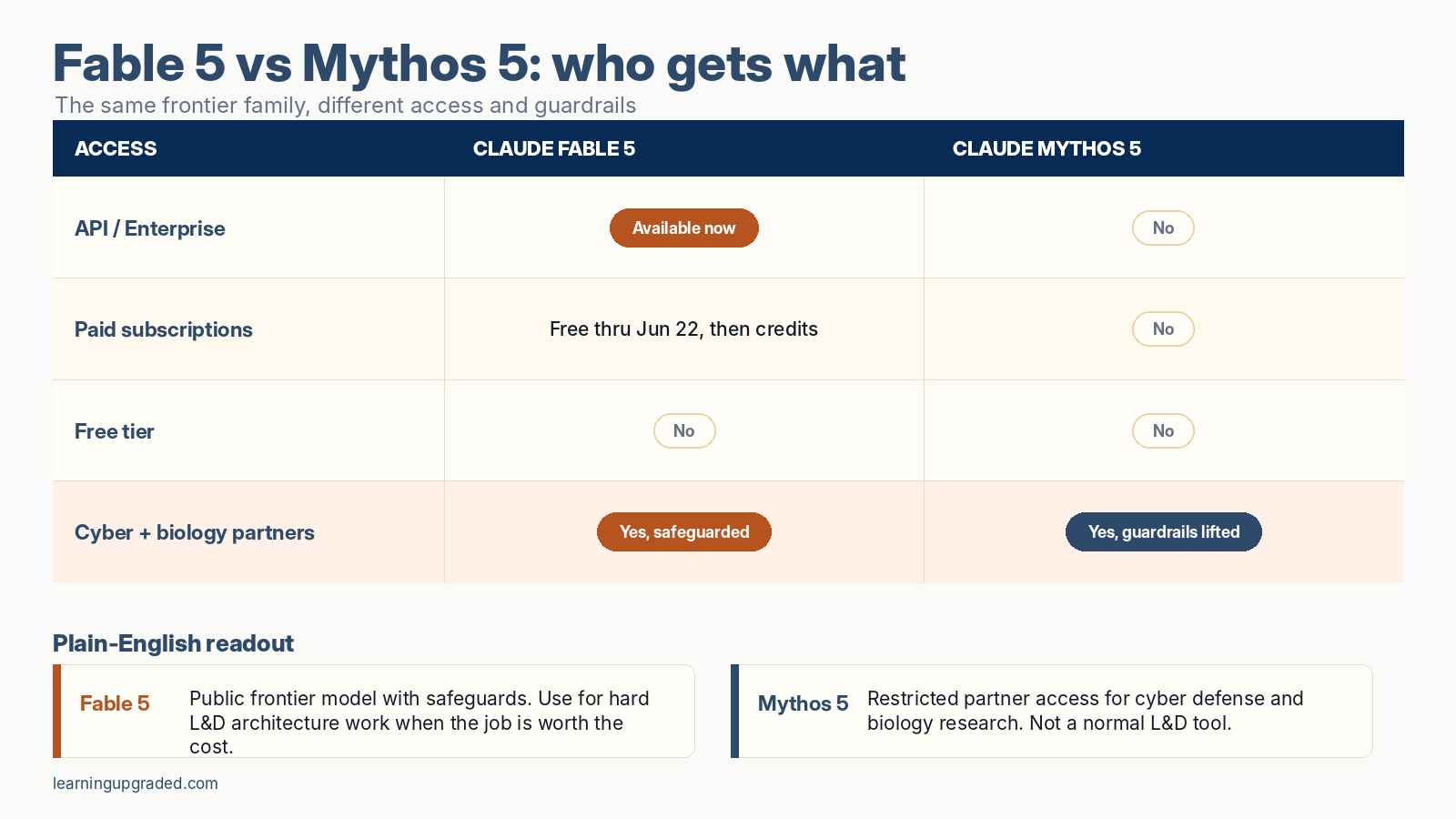
This is the part I had to read three times, because access to Fable 5 is more staged than a normal launch, and there are really two different models wearing similar names.
Fable 5 is the one you can get. On the API and on consumption-based Enterprise plans, it’s fully available as of today. On paid subscriptions (Pro, Max, Team, and seat-based Enterprise), Anthropic is rolling it out in stages because they expect demand to be brutal. It’s included on those plans at no extra cost from today through June 22. On June 23, they pull it back, and using it after that runs on paid usage credits until capacity lets them fold it back in. No date on that yet. You’ll find it on Claude.ai, in Cowork, and through the cloud platforms (AWS Bedrock, Google Vertex AI, Microsoft Foundry).
The free tier doesn’t get it. The staged rollout covers paid plans only. If you’re on a free account, Fable 5 isn’t in your picker, and the honest move is to use the next two weeks on a colleague’s paid plan or your own trial if you want to see it before deciding.
Mythos 5 is the one almost nobody gets. Same underlying model, guardrails lifted, and it’s locked to Project Glasswing’s cyber-defense partners, with a small group of biology researchers joining soon. Unless you work in critical infrastructure security or a vetted life-sciences lab, Mythos 5 is not a thing you’ll touch. When the coverage talks about a model finding thousands of vulnerabilities, that’s Mythos, and it stays behind the glass.
A few limitations worth naming plainly. You can’t hand-tune how hard Fable 5 thinks inside Claude.AI or Cowork, because it sets its own depth there (only the API and Claude Code expose that dial). The big 1-million-token context you’ll see quoted is an API number; the chat plans most of us use still cap lower, so a true “dump the entire library in at once” job belongs on the API rather than the chat box. And the access you get today on a subscription is temporary by design. Plan around June 23, not around what’s in your picker this morning.
Where Fable 5 earns its price 🛠️
The rule I’m landing on: reach for Fable 5 when the cost of getting it wrong across many steps is higher than the cost of the tokens. That’s a narrower set of jobs than the hype suggests. Here’s where it fits, by role.
For Instructional Designers: the full-architecture build you’ve been scoping for a month. When I led a 26-person team, the projects that stalled longest weren’t the hard modules. They were the giant ones nobody could find a clean starting edge on. A whole onboarding curriculum sitting in a pile of SME notes, old decks, and job aids. This is the work Fable 5 is built for, because the value is in holding the entire mess in its head at once.
Try this prompt:
Here are 40 pages of SME interview notes, our competency model, and three legacy training decks. Build a complete onboarding curriculum architecture for a new customer support hire: a module map, learning objectives per module, a logical sequence with prerequisites called out, and a first-draft assessment plan. Flag every place the source material contradicts itself or leaves a gap you had to guess at, and tell me what you'd ask a SME to resolve each one.For Learning Managers and Ops: dense synthesis across more material than you can hold. Reading a 200-page compliance regulation, mapping it to objectives, and gap-checking it against what you already have built. This is where the long-context focus pays for itself, and where a cheaper model starts strong and drifts by page 60.
Try this prompt:
I'm responsible for keeping our compliance training current and audit-ready. Attached is the full text of [regulation] and a list of our existing compliance modules with their learning objectives. Map every requirement in the regulation to an objective we already cover. Then give me three lists: requirements with no matching content, modules that reference rules that have changed, and the five highest-risk gaps to close first. For each of the five, name the factor that drove its ranking: regulatory exposure, how many people it affects, and how recently the rule changed.For content and dev teams: pulling legacy materials out of image jail. Fable 5 is the new state-of-the-art in vision. Most of us have a graveyard of old courses that exist only as screenshots, PDFs, or slides, with no source files. It can reconstruct the logic of a deck from images alone. (Because none of us have ever gotten a PPT or PDF of something we didn’t create before.)
Try this prompt:
These are screenshots of an old 30-slide compliance course we lost the source files for. Reconstruct it as a structured storyboard: slide-by-slide content, the implied learning objectives, on-screen text, and narration notes. Mark any slide where the instructional intent is unclear from the visual alone so I can confirm it with the original author.Talking to Fable 5 is a little different 🗣️
Anthropic published a separate prompting guide for this model, and a few things in it are worth knowing before you paste those prompts in. They’re the reason the prompts above are written the way they are.
Give it your hardest work. Anthropic says straight out that testing Fable 5 on simple tasks undersells it. It’s built for the long, ambiguous, multi-step jobs, so hand it the project that scares you a little. The curriculum-architecture prompt is exactly in its lane.
Give it the why behind your request, beyond the what. Fable 5 does better work when it knows the intent behind the request. “Build me a module map” gets less than “I’m onboarding a support team in six weeks and they need to be taking live tickets by week three, so build me a module map.” The reason shapes the output, which is why each prompt above opens with the situation.
Don’t ask it to “show its reasoning.” This one caught me off guard. In Fable 5, telling the model to explain or walk you through its internal thinking can trigger a safeguard and quietly route your request to Opus 4.8. Ask for the conclusion and the criteria behind it as part of the deliverable, the way the compliance prompt asks for the factor behind each ranking, and you stay on Fable 5.
Be less prescriptive than you’ve trained yourself to be. If you’ve built up a giant rule-stuffed prompt that worked on older models, it can drag Fable 5’s output down. Say what you want plainly and let it work. If you live in Claude Code or the API, set effort to “high” as your default and save “xhigh” for the gnarliest jobs.
🚫 When to leave it in the drawer
This is the part I want us to sit with, because the instinct with a shiny top-tier model is to use it for everything. That instinct gets expensive fast.
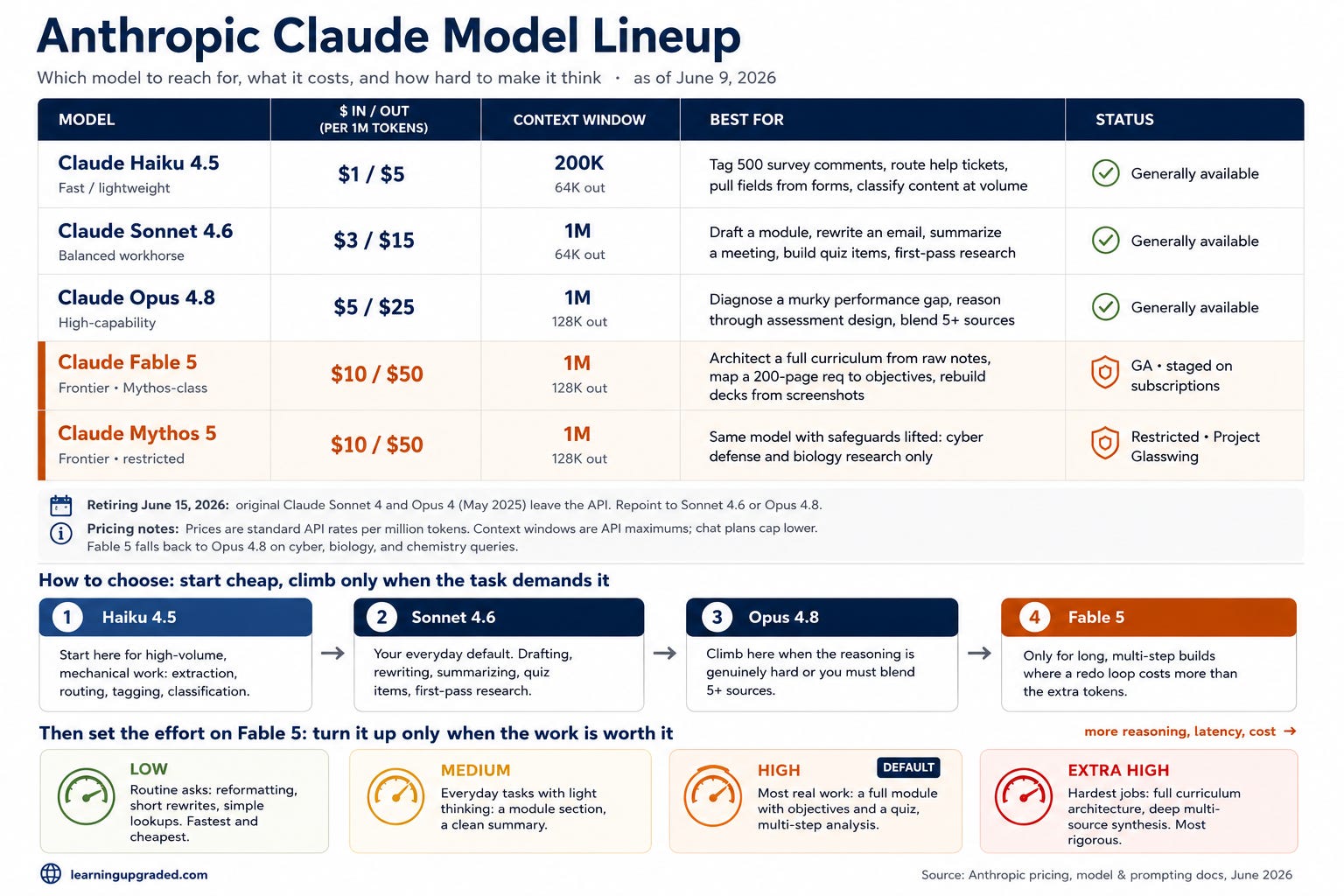
Routine drafting, rewrites, and summaries belong on Sonnet 4.6. Your weekly email, quiz items, module copy cleanup, and meeting notes. Sonnet handles them at a third of the price and with plenty of quality. Using Fable 5, here is paying steakhouse prices for a sandwich.
High-volume repetition is the other trap. If you’re running the same prompt across fifty modules, the token math compounds in a hurry. Default to the cheap model and escalate only the items that truly stall.
And skip Fable 5 entirely if anything’s going to trip the safeguards. If your work brushes security, lab biology, or chemistry, you’re getting handed to Opus 4.8 on those queries anyway. Save the round trip and start in Opus.
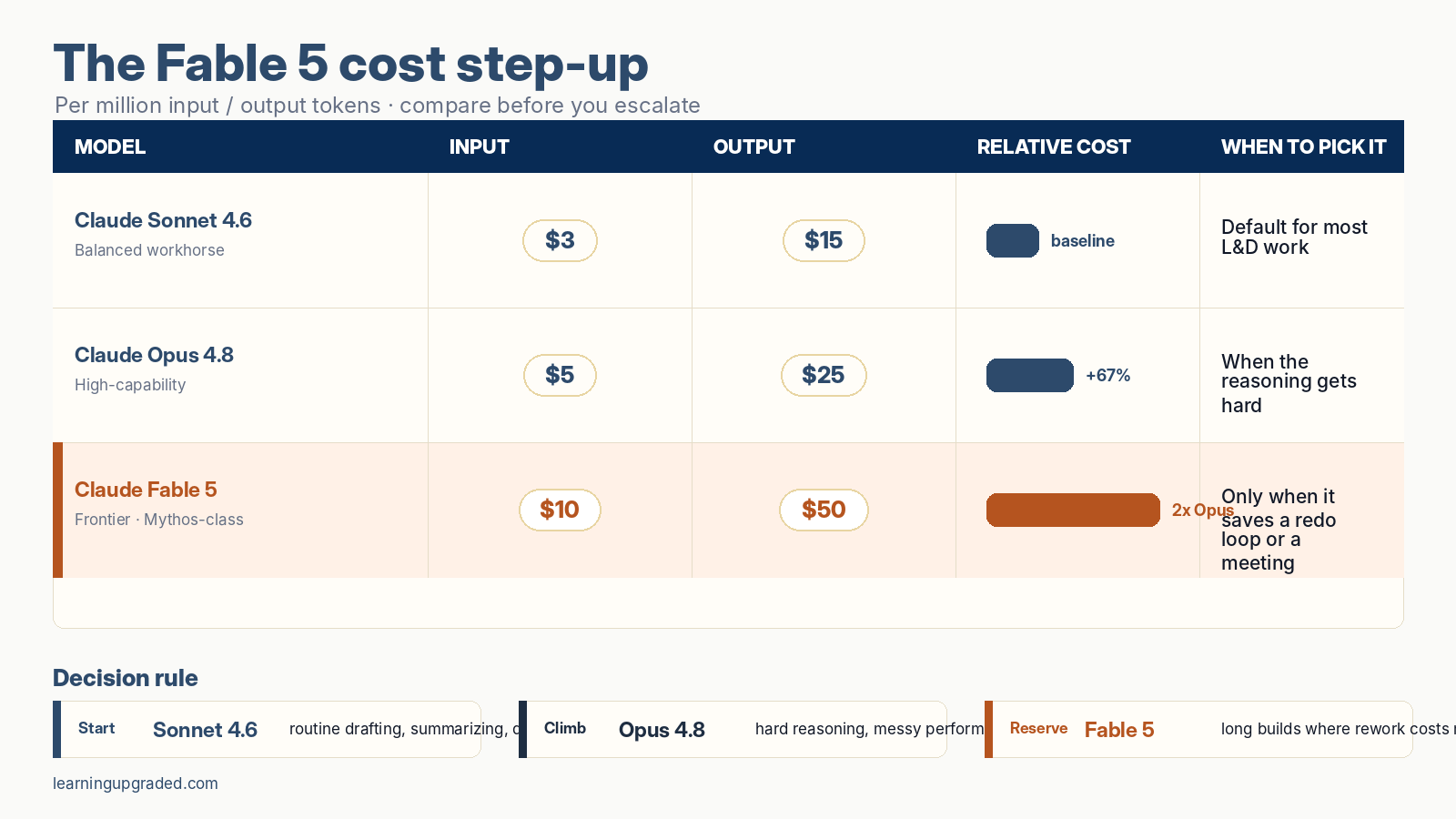
The ladder I’m testing this week: start in Sonnet 4.6, climb to Opus 4.8 when the reasoning gets hard, and only pull Fable 5 when the extra muscle clearly saves a redo loop or a meeting. I’ll tell you where that ladder breaks, because it will.
The cost story, with both deadlines 💰
Start with the sticker price, because it’s the thing that changes how you’ll use it. Fable 5 runs at $10 per million input tokens and $50 per million output tokens. That’s double Opus 4.8 and more than triple Sonnet 4.6. Same job, two to three times the bill, every time you pick it. That math is the whole reason the ladder above matters.
On top of the price, two separate clocks are ticking this month, and the internet is mashing them into one scary headline.
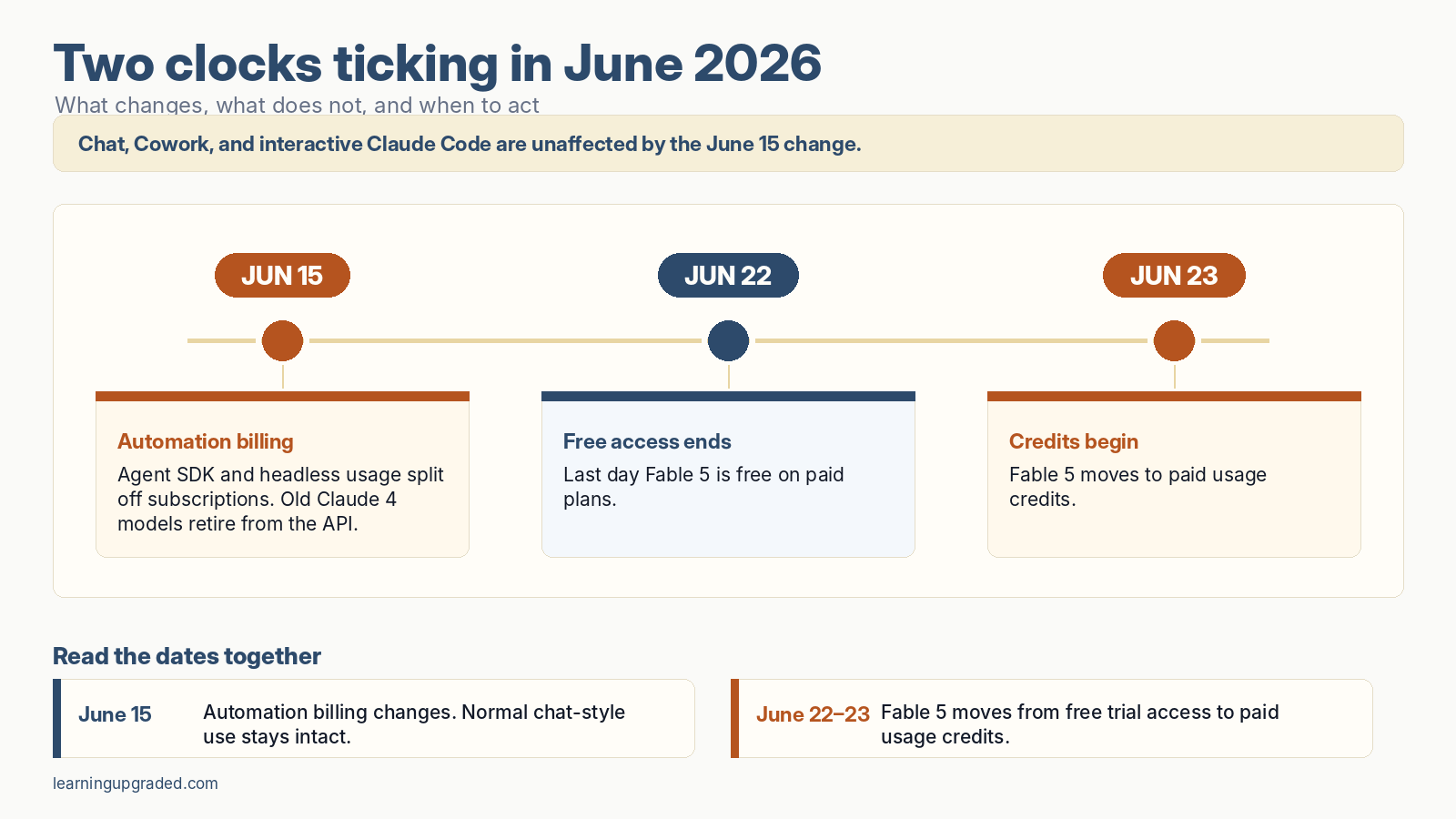
The first clock is active, and it runs out on June 22. I covered this above: Fable 5 is free on paid subscriptions through June 22, then moves to usage credits on June 23. That’s the window I’d put on a sticky note.
The second clock is June 15, and it only touches automated agents. Anthropic announced on May 14 that it’s separating automated, programmatic usage from subscriptions. The Claude Agent SDK, the headless command-line mode, Claude Code GitHub Actions, and third-party tools that log in through your subscription all move to a separate monthly credit, billed at API rates, sized to your plan per person, with no rollover.
Now read this next line twice, because it’s the part that should lower your shoulders. If you use Claude the way most of us in L&D use Claude, nothing changes on June 15. This includes chatting on Claude.ai, working in Claude Cowork, driving Claude Code by hand in the terminal: all of it stays exactly as it is now. Drawing from your normal plan usage limits every 5 hours. The June 15 change only bites the run-it-overnight, no-human-watching automations. It’s making noise because heavy agent users had been quietly pulling fifteen to thirty times their subscription’s worth of compute, and that subsidy is ending. So if you have something automated, usage credits/billing will start next week.
One footnote worth a calendar entry: June 15 is also the day the original Claude 4 models from May 2025 retire from the API. If you’ve got anything pinned to those old model names, repoint it to Sonnet 4.6 or Opus 4.8 before then, or it starts throwing errors.
💡 What does this all mean?
We spent months treating Mythos like a legend, and now the safe version is in our hands. The easy reaction is to treat raw capability as the whole story. It isn’t. Read the launch closely, and the story Anthropic is telling is about discipline.
Three signals stack up. The model hands you off to a cheaper one when you ask the wrong kind of question. It leaves subscriptions in two weeks unless you pay per use. And agent automation gets walled off from chat on June 15. Put together, that’s a company drawing a hard line between human-in-the-loop work and machine-paced loops, and pricing them like the different things they are.
For us, that’s clarifying. We keep treating this as a “use the best model” question. The real skill is knowing which model the job in front of you deserves, and being honest about when the premium one is worth it. That’s a judgment problem dressed up as a tooling problem, which happens to be the thing we’re good at. Every LMS migration I’ve run taught me the same lesson in a different outfit: the expensive mistakes were never about the tool, they were about reaching for the wrong one and not noticing until the cleanup.
I’m spending the next two weeks running real curriculum-architecture work through Fable 5 while it’s free, putting it head-to-head against Opus 4.8 on identical briefs, and keeping notes on where the extra cost paid for itself and where it didn’t. That comparison is going straight into the AI-native L&D operating system I’m building, where “which model do I open for this?” is becoming its own documented decision instead of a shrug.
🎯 The one thing to do this week
Before June 22, take one big, intimidating, multi-step project you’ve been putting off, the kind that needs a full architecture and not a quick draft, and run it through Fable 5 while it’s free. Then run the same brief through Opus 4.8. Notice where the gap is real and where it isn’t. That single side-by-side will teach you more about when to spend on the top tier than any benchmark chart will.
The full model-selection map and the running comparison notes are sent via the newsletter at learningupgraded.com.
We’re figuring this one out together, in real time, with the meter running. Let’s pay attention to what it’s telling us.
—Eian