
Managers Are the Missing Piece of AI Adoption
Why getting them ready is the highest-impact move any AI adoption initiative should make in the first 90 days.


☕ 10 minute read
Every AI adoption initiative I’ve seen has the same blind spot. We focus on the employees. We build the training. We launch the tools. We forget that 80% of daily work behavior is shaped by the person they report to.
A manager who ignores AI quietly tells their team it doesn’t matter. A manager who uses AI visibly normalizes experimentation. That signal travels faster and lands harder than any eLearning module we could build.
The math is simple. One capable manager coaching a team of ten multiplies every training dollar we spend. One disengaged manager silently kills the adoption of that same team. The highest-yield point in the entire capability system is the management layer, yet most organizations still skip it.
If we’re serious about AI adoption, we have to start with managers. Most haven’t, and that’s the gap I want to close in this piece.
📋 TL;DR
Managers shape daily behavior more than any training program can
Most AI initiatives skip manager enablement entirely, which caps adoption at 10-15%
Building manager capability around AI coaching is the highest-impact early investment in AI adoption, and it needs executive sponsorship to land
🔍 The Manager Signal Problem
Think about the last time your organization rolled out something new. A process change, a tool, a policy update. What determined whether your team adopted it?
The training was part of it. The bigger driver was probably your manager, and whether they used it, talked about it, asked about it, or expected it. That signal carried more weight than the workshop.
Managers are the single most powerful distribution channel for organizational behavior. They set norms. They allocate time. What they reward gets repeated. What they ignore goes quiet. They coach in real-time, in context, in the moments that matter.
When we invest millions in AI tools and training but skip manager enablement, we’re building a broadcast system with no signal repeater. The message reaches people once, in a training session. Then it fades, because nothing in their daily environment reinforces it.
This is a change-leadership problem with a training component, and the fix has to reside at the management layer. Supported by HR, learning, and executive sponsors, but owned at the management layer. No single function can carry it alone.
🏗️ What Managers Need to Be Able to Do
Most managers are in the same position as their teams. Uncertain about AI. Unsure how to use it. Unclear about expectations. They carry an extra burden, though. They’re supposed to coach something they haven’t figured out themselves.
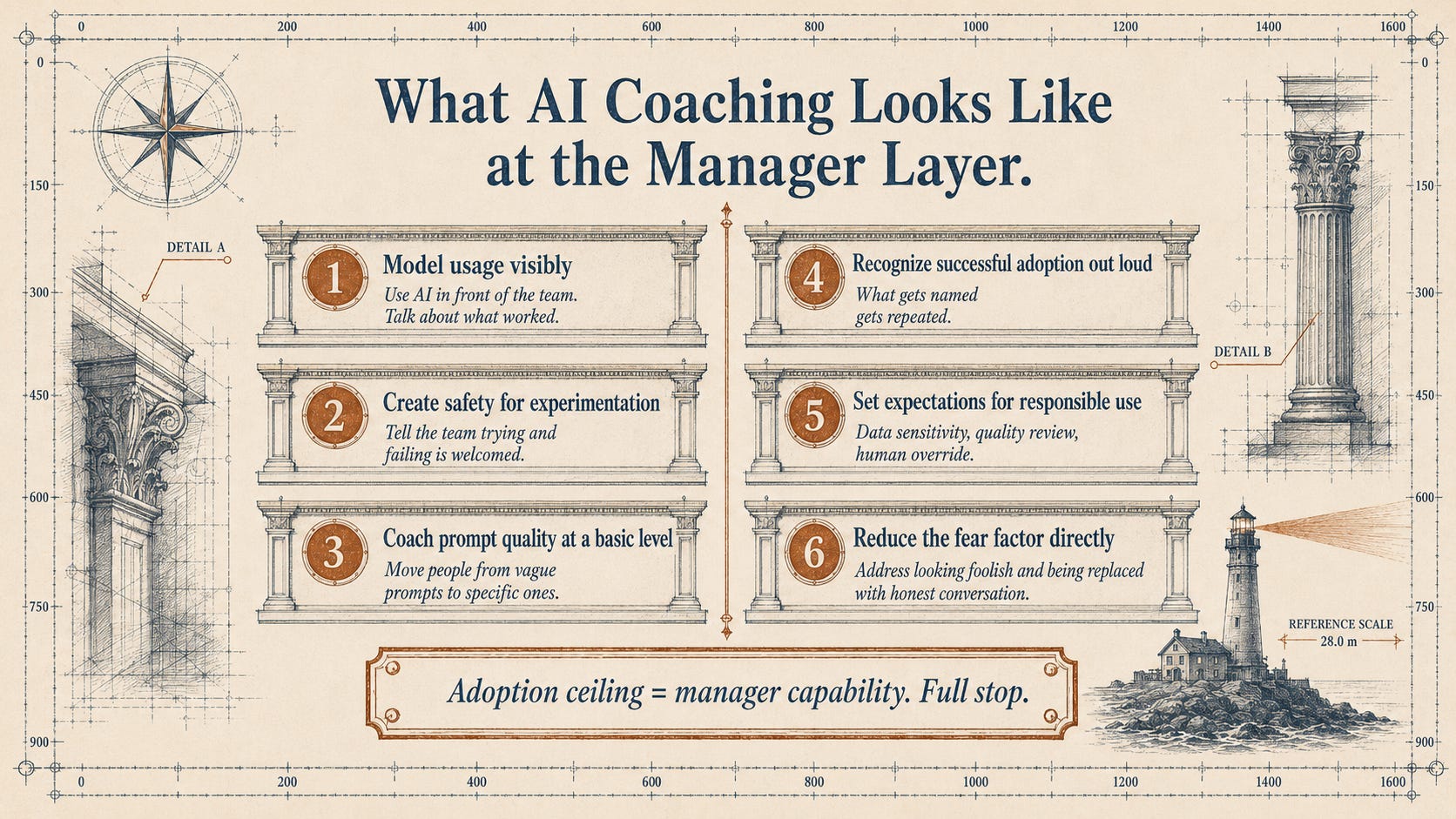
Here’s what managers need to be able to do for AI adoption to stick:
Model usage visibly. Use AI in front of the team. Share what they’re using it for. Talk about what worked and what didn’t. “I used Claude Sonnet 4.6 to draft this agenda, and it saved me 20 minutes.” It does more for adoption than a training session.
Create safety for experimentation. Explicitly tell their team that trying AI and failing is expected and welcomed. “I want you to spend an hour this week experimenting with AI on a real task. Tell me what you tried in our next 1:1.” That’s a specific, bounded invitation that reduces fear.
Coach prompts quality at a basic level. Enough to help someone move from “write me an email” to “draft a follow-up email to this client using a professional tone, referencing these three discussion points.” Basic coaching makes a real difference at Stage 2 of the fluency model.
Recognize successful adoption out loud. When someone uses AI effectively, name it in a team meeting. Celebrate the experiment, even when the result was mixed. What gets recognized gets repeated.
Set expectations for responsible use. Be clear about what AI should and shouldn’t be used for. Data sensitivity. Quality review requirements. When human judgment must override AI suggestions. This builds confidence that people are using the tools appropriately.
Reduce the fear factor directly. Most people are afraid of two things with AI. Looking foolish and being replaced. Managers who address both concerns through honest conversation, beyond corporate talking points, unlock experimentation that wouldn’t otherwise happen.
That’s a coaching agenda. It sits in a different muscle from tool training, and it draws on leadership skills the L&D and HR functions have been building together for years. Applied to a new context.
📐 The Coaching Gap
When I hired and developed 5 managers across a global team, the thing I spent the most time on wasn’t technical skills. It was coaching capability. How to give feedback. How to develop people. How to hold standards while creating psychological safety.
AI adoption requires the same coaching investment, and almost nobody is making it.
Most manager training programs, where they exist at all, focus on tools. “Here’s how to use the AI dashboard.” That’s necessary and nowhere near sufficient. Managers need coaching skills specific to AI adoption:
How to have the “AI won’t replace you” conversation authentically
How to identify which team members sit at which fluency stage
How to design team experiments that are bounded and safe
How to debrief AI experiments in a 1:1 without turning it into a performance review
How to distinguish capability gaps from resistance, which are different problems with different fixes
How to advocate for workflow changes upward when their team identifies them
Those are leadership skills applied to a new context. We know how to build this. We just haven’t prioritized it for AI.
🔬 What Happens When You Skip Managers
I’ve watched this play out. The organization launches AI training. Individual contributors attend. Some of them get excited. They start experimenting. Then they hit the manager's wall.
The manager doesn’t use AI, so they don’t understand the time investment experimentation requires. They see an employee “playing with ChatGPT” and assume they’re not doing real work. They don’t ask about AI in 1:1s. They don’t recognize AI-assisted improvements. Gradually, the early adopters stop experimenting because the organizational signal says it doesn’t count.
This is how adoption plateaus at 10-15%. You have a core of enthusiasts who were going to adopt regardless, and everyone else is waiting for permission that never comes because the permission-givers were never enabled.
The adoption ceiling is set by the manager's capability. The companies that beat the 10-15% number have invested in their managers as the concentration point for behavior change. The ones stuck at 10-15% are funding more employee training and wondering why the curve isn’t moving.
🧩 What Executive Sponsors Have To Do
Manager enablement can’t carry the whole load alone. It needs air cover, and that’s where executive sponsors come in. Here’s what visible executive support looks like:
Name AI capability as a leadership expectation. When the CEO and senior leaders say out loud that every people leader is expected to coach AI-assisted work, the calendar opens up. Without that signal, managers deprioritize AI coaching because they have ten other priorities competing for their attention.
Model AI usage at the top. Senior leaders who use AI in their own work, talk about it publicly, and reference what they’ve tried, give cover to every manager below them. Without it, AI feels like an individual contributor thing that leadership endorses and doesn’t practice.
Fund the time. Manager development for AI coaching takes hours, beyond minutes. If managers are already underwater, adding this without protecting time signals that it isn’t a priority. Executive sponsors have to make the time math work.
Hold managers accountable for adoption metrics. When manager performance reviews include team-level AI adoption, manager behavior shifts fast. Until that connection exists, AI coaching stays optional in practice even when it’s stated as a priority.
Defend the experiments that don’t work. When a team tries something with AI, and it produces a mediocre result, executives need to publicly defend the learning rather than punish the attempt. One visible punishment shuts down dozens of would-be experiments across the org.
This is the change leadership layer of AI adoption. It can’t be delegated to learning teams. It has to be owned at the executive level, with operational support from People, IT, and Operations. The AI Adoption & Capability Lead’s role here is to make executive sponsorship visible and operational, rather than merely substitute for it.
📊 Measuring Manager Readiness as a Leading Indicator
Manager readiness is one of the strongest leading indicators of AI adoption success, and it’s measurable.
Here’s what to track at the manager level:
Self-reported AI usage frequency
Manager-led team discussions about AI in a typical month
Percentage of 1:1s that include an AI experiment debrief
Adoption rate of teams reporting to a given manager
Sentiment scores from team members about manager support for AI experimentation
Roll those metrics up by function, by org, by tenure. Look for patterns. The high-adoption teams almost always trace back to a small set of high-capability managers. The low-adoption teams almost always have a manager-readiness gap.
When the data shows up that clearly, the executive conversation gets easier. “We need to invest in manager development in these four functions because that’s where the ceiling is” becomes a fundable ask, backed by leading indicators rather than gut feel.
🧭 Building Manager Enablement Into Every Initiative
Here’s the operational shift. Stop treating manager enablement as a separate track. Build it into every AI adoption initiative from the start.
Before the employee training launches, run a manager working session. A space where managers practice the coaching conversations they’ll need. Let them role-play the “AI won’t replace you” conversation. Let them struggle with it. Let them hear how their peers handle it.
During the rollout, give managers a simple weekly rhythm. One question to ask in team meetings: “Who tried something with AI this week? What happened?” One prompt for 1:1s: “What’s blocking you from experimenting more?” Those two questions change the signal.
After the initial push, measure manager behavior alongside employee adoption. Are managers using AI themselves? Are they asking about it in 1:1s? Are their teams adopting at higher rates than teams with disengaged managers? That correlation tells you where to allocate the next investment.
When we built learning systems that scaled across three continents, the thing that held it together wasn’t the content. It was the managers who reinforced expectations, coached their teams, and maintained daily quality standards. The system worked because the people closest to the work were enabled to make it work.
AI adoption follows the same pattern. The system works when managers are equipped to make it work.
💡 What This All Means
We keep building AI training for employees and skipping the people who shape daily behavior. That’s like building a curriculum without telling the teachers about it.
Manager enablement is the highest-impact early investment in AI adoption. One capable manager coaching a team of ten multiplies every training dollar. One disengaged manager silently kills the adoption of that same team. The math is brutal, and most organizations are still on the wrong side of it.
The question worth sitting with: how many of your managers could confidently coach an employee through their first real AI experiment right now? If the answer is “not many,” that’s where the next investment goes. And the executive sponsors who fund it earn the adoption curve they were hoping for.
This is Part 4 of a six-part series on building AI capability. The next piece covers how to measure AI adoption beyond completion rates.
👉 Subscribe to Learning, Upgraded to get the full series.
—Eian