
Building an AI Capability Operating System
The framework, the role that runs it, and the operating rhythm that keeps it alive.

☕ 13-minute read.
We’ve spent this series pulling apart why AI adoption stalls. Capability gaps. Maturity mismatches. Absent managers. Vanity metrics. All real problems. Naming problems without offering a system to address them is commentary, though, and the gap I want to close in this final piece is between commentary and operating model.
Here’s the system.
What follows is how I think about building AI capability as an operating system. A coordinated set of layers that continuously produce capability. The layers connect. The rhythm sustains them. It’s informed by years of building L&D infrastructure at scale, by every mistake I made trying to make training stick, and by the conviction that capability work is organizational infrastructure. The operating system has nine layers, plus a tenth that keeps the others honest. Each layer connects to the ones above and below. Skip a layer and the system breaks.
This piece is also where I name the role profile this work has created. AI Adoption & Capability Lead. Workforce Transformation Director. Organizational Capability Manager. Different titles, same core mandate. Build the system that delivers different outcomes for the business from AI investment. Run it. Iterate it. Hold the partners accountable for the layers they own.
📋 TL;DR
AI capability requires an operating system that adapts continuously. Programs expire; systems evolve.
The system connects executive vision to business outcomes through ten integrated layers
Whoever can architect and run this system is doing the work behind a category of roles that didn’t exist two years ago, and the market is still figuring out what to call it
🔍 Why Programs Stall and Systems Adapt
Programs have start dates and end dates. They launch, they run, they finish. Someone writes a report. Everyone moves on.
AI capability doesn’t work that way. The tools change quarterly. The use cases evolve as people learn. The organizational readiness shifts as managers get comfortable or don’t. A program designed in January is partially obsolete by April. Systems adapt. Programs expire. That’s the core difference.
When my team migrated across three LMS platforms, each migration could have been treated as a program. Plan, execute, close. Instead, we treated each one as a phase in a continuous capability system. The governance structures we built for the first migration informed the second. The change management playbook evolved with each iteration. The measurement framework got more sophisticated over time.
By the third migration, we had a system capable of handling organizational change at scale. Technology change was the surface of the work. Organizational change was the underlying lift. That’s what AI capability requires. A system designed for continuous adaptation, owned at a level that crosses functions, and resourced for the long run.
📐 The Nine Layers
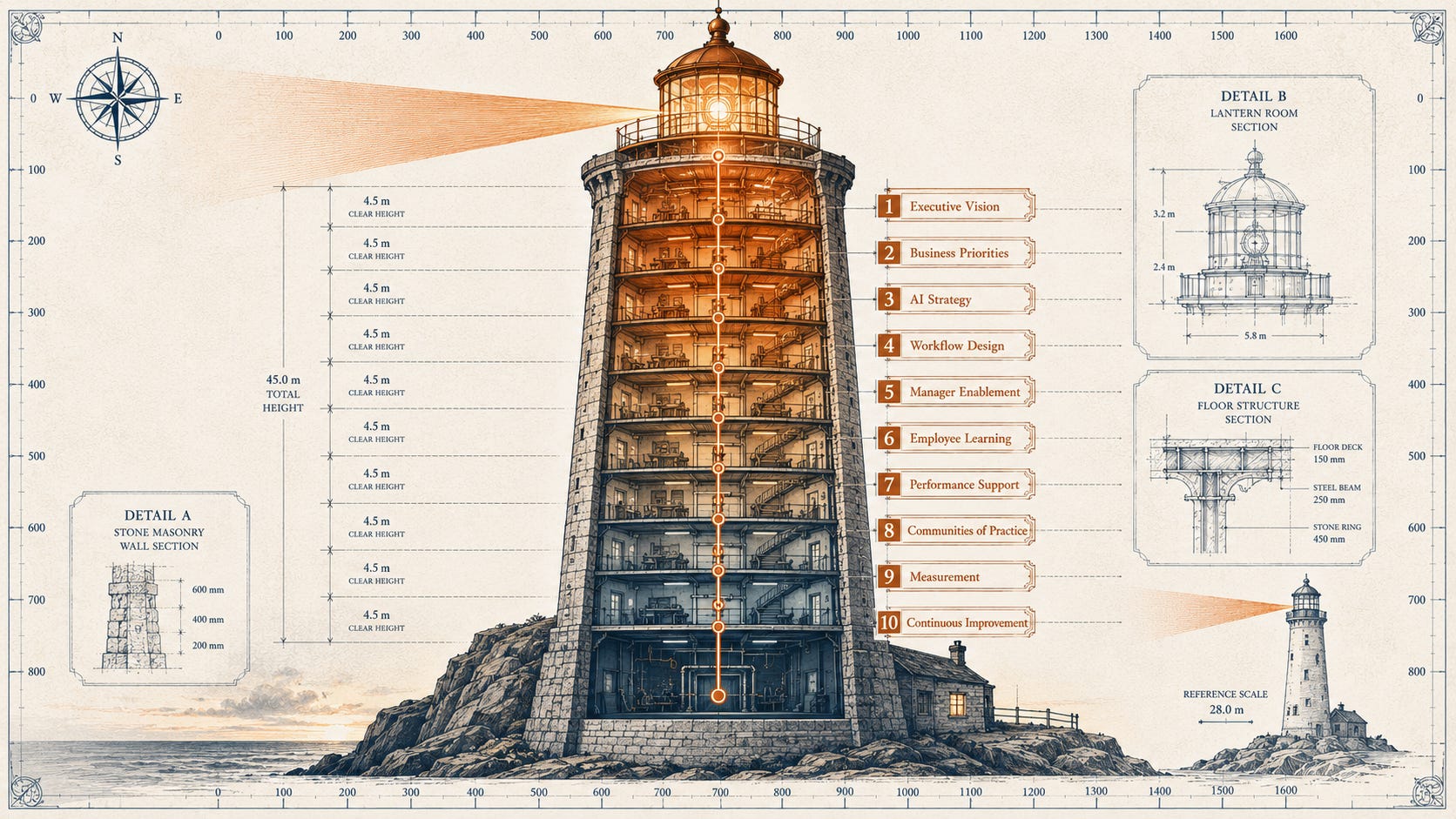
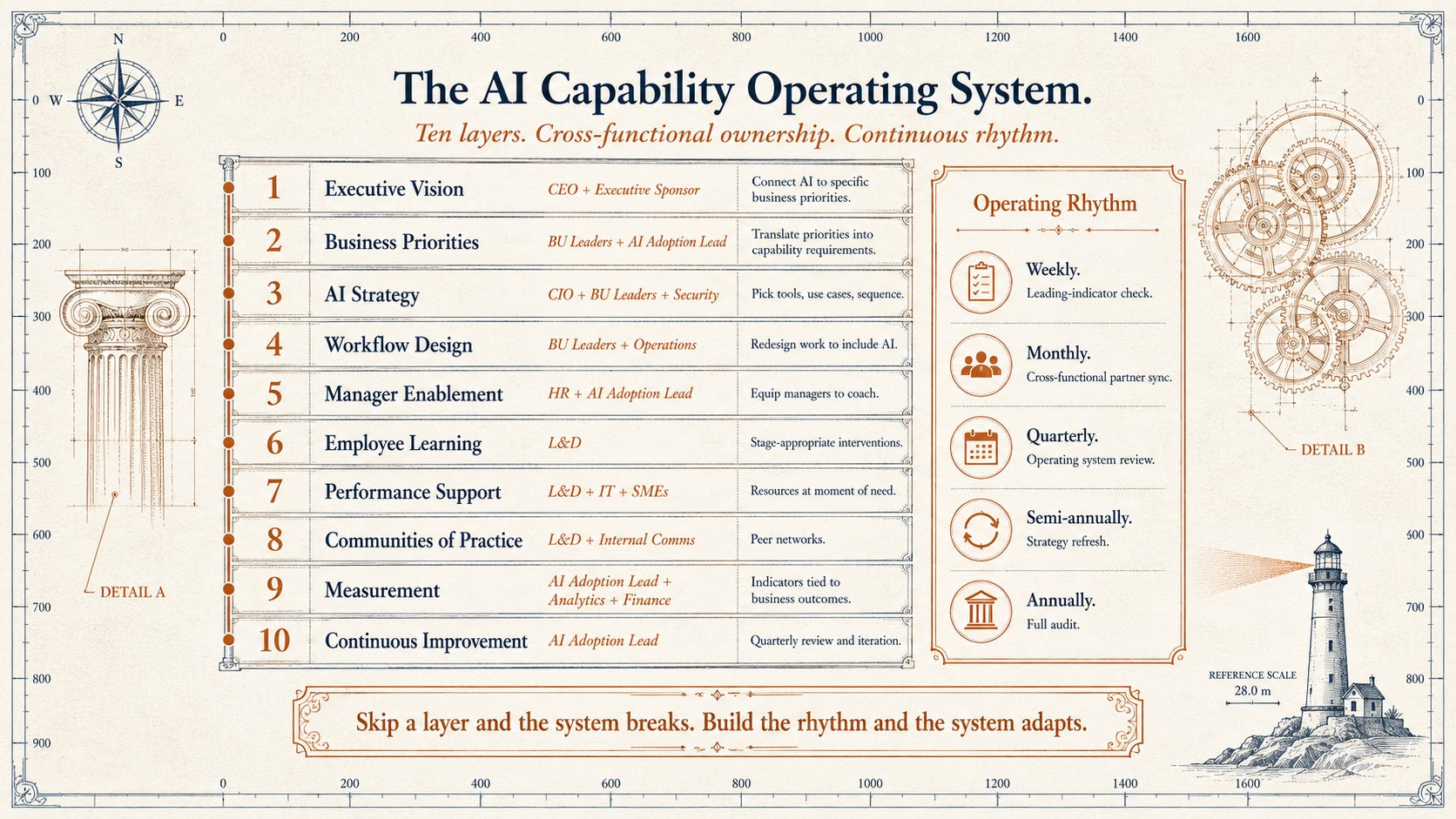
Here’s the operating system, top to bottom. Each layer connects to the one above and below. Skip a layer and the system breaks.
Layer 1: Executive Vision
What it is: Clear, communicated alignment on why the organization is investing in AI capability.
What it requires: Executives who can articulate something more than “we need to use AI.” They have to connect AI capability to specific business priorities. “We’re investing in AI capability because we need to reduce time-to-market by 30% in the next 18 months.” That’s a vision the capability system can work with.
Cross-functional owner: CEO + executive sponsor (often the COO, Chief People Officer, or CIO depending on org structure).
Where it breaks: When the executive sponsor says, “just make sure everyone knows how to use AI,” and then disappears. Vision without specificity produces activity without direction.
What the AI Adoption Lead does here: Translate vague vision into specific capability requirements. Push back on briefs that aren’t fundable.
Layer 2: Business Priorities
What it is: The specific business outcomes AI capability should serve.
What it requires: Translation work. Moving from “reduce time-to-market” to “these three teams need to redesign these five workflows using AI to eliminate these specific bottlenecks.” That translation is a skill, and people who can do it become indispensable.
Cross-functional owner: Business unit leaders, with facilitation from the AI Adoption Lead.
Where it breaks: When the capability team accepts “train everyone on AI” as a sufficient brief. Push back. Ask “to achieve what?” Keep asking until the answer is specific enough to measure.
What the AI Adoption Lead does here: Facilitate the translation. Map priorities to behaviors. Build the case for which behaviors get the early investment.
Layer 3: AI Strategy
What it is: Which tools, which use cases, which teams, in what order.
What it requires: Partnership with IT, Security, and business unit leaders. The capability team doesn’t own AI strategy, and we have to be in the room when it’s made. If the strategy prioritizes sales automation and the capability team builds a generic prompt engineering course, we’ve wasted everyone’s time.
Cross-functional owner: CIO + business unit leaders + Security.
Where it breaks: When strategy is set without considering the human capability required to execute it. This is the moment to add value early.
What the AI Adoption Lead does here: Be the voice for human capability inside the strategy conversation. Surface the implementation risk before the strategy is locked in.
Layer 4: Workflow Design
What it is: Redesigning how work gets done to include AI.
What it requires: Process mapping with the teams who do the work. Where does AI fit? What steps change? What steps go away? What new steps emerge? This is where the shift from “AI as extra tool” to “AI as integrated workflow component” happens.
Cross-functional owner: Business unit leaders + Operations, with facilitation from the AI Adoption Lead.
Where it breaks: When workflow redesign is left to individual employees. Most people add AI on top of existing processes rather than redesign the process itself. That creates more work over time. Team-level workflow redesign with facilitation produces better results.
What the AI Adoption Lead does here: Facilitate the redesign sessions. Bring the systems-thinking discipline. Hold the team accountable for explicitly naming the new workflow.
When we cut our content approval cycle from six weeks to two, the lift came from redesigning the workflow. Training on the new tools came after, and it was the smaller part. We changed who reviewed what, when, and how. The tools enabled the change. The workflow redesign was the change.
Layer 5: Manager Enablement
What it is: Equipping managers to model, coach, and reinforce AI adoption.
What it requires: Everything we covered in Part 4 of this series. Coaching skills, experimentation frameworks, recognition practices, honest conversations about fear and uncertainty.
Cross-functional owner: HR + AI Adoption Lead, with executive sponsorship to make it a leadership expectation.
Where it breaks: When it’s skipped entirely, which happens in the majority of AI rollouts I’ve seen.
What the AI Adoption Lead does here: Design the manager enablement curriculum. Measure manager readiness as a leading indicator. Hold executive sponsors accountable for protecting manager time.
Layer 6: Employee Learning
What it is: Stage-appropriate learning interventions matched to where people are in the fluency maturity model.
What it requires: Assessment, segmentation, differentiated pathways. The work breaks one-size programs into stage-matched interventions. Awareness programs for Stage 1, experimentation labs for Stage 2, workflow integration support for Stage 3, innovation challenges for Stage 4.
Cross-functional owner: L&D, with input from business unit leaders on use cases.
Where it breaks: When we build one program and aim it at all stages simultaneously. It serves no one well.
What the AI Adoption Lead does here: Set the architecture for the pathway. Make sure each stage has matched content and matched support.
Layer 7: Performance Support
What it is: The resources that help people at the moment of need, after the training is over.
What it requires: Prompt libraries, job aids, templates, help channels, peer communities, FAQ repositories. Updated regularly as tools and use cases evolve.
Cross-functional owner: L&D + IT + functional SMEs, with facilitation from the AI Adoption Lead.
Where it breaks: When training is treated as the entire intervention. The real learning happens at the point of application. If nothing exists to support that moment, the training evaporates.
This is one of the lessons that hit me hardest. When we scaled from 50 to 637 modules in a single year, the modules were only part of the system. The role-based pathways, the completion gate, the certification layer on top of completion, the ongoing maintenance cadence. Those were the performance support structures that turned content into capability.
What the AI Adoption Lead does here: Set the standards for what performance support exists for each tool and use case. Hold someone accountable for keeping it up to date.
Layer 8: Communities of Practice
What it is: Peer learning networks where AI practitioners share what’s working, troubleshoot problems, and push each other forward.
What it requires: Facilitation (communities don’t sustain themselves), executive visibility (so participation is valued), and enough structure to be useful without so much structure that it feels bureaucratic.
Cross-functional owner: L&D + internal comms + community-of-practice leads, with executive sponsorship.
Where it breaks: When communities are launched with a Slack channel and no facilitation plan. They go quiet inside two weeks.
What the AI Adoption Lead does here: Establish the community structure. Recruit and develop the community leads. Make sure community insights feed back into the rest of the operating system.
Layer 9: Measurement
What it is: The six operational indicators from Part 5. Adoption Rate, Usage Frequency, Workflow Penetration, Confidence, Quality, and Business Impact. Plus the data partnerships and reporting cadence that keep them honest.
What it requires: Data partnerships, measurement infrastructure, and the discipline to report outcomes to leadership. Activity metrics get relegated to internal hygiene.
Cross-functional owner: AI Adoption Lead + analytics + finance + business unit leaders.
Where it breaks: When the capability team reports completion and wonders why the budget gets cut.
What the AI Adoption Lead does here: Own the measurement system end-to-end. Build the dashboard. Set the cadence. Translate the numbers for each audience.
The Tenth Layer: Continuous Improvement
I listed nine, and there’s always a tenth. The system itself has to evolve. AI tools change. Organizational readiness shifts. New use cases emerge. What worked last quarter might miss next quarter.
Build review cycles into the operating system. Quarterly at minimum. What’s working? What’s stalled? What’s changed? What do we need to adjust?
When I managed a 26-person global team, what kept our systems running across three continents and multiple time zones was regular, honest review. What assumptions had we made that turned out to be wrong? What processes needed updating? Where was friction building? That same discipline applies to an AI capability operating system, scaled across an entire organization.
⚙️ The Operating Rhythm
The nine layers describe the architecture. The operating rhythm describes how the system runs over time. Here’s the cadence I’d use:
Weekly: The AI Adoption Lead checks the leading indicators. Manager readiness signals. Stage movement rates. Active user counts. Workflow redesign progress. Adjusts where the team is investing facilitation time.
Monthly: Cross-functional partner sync. Performance support inventory check. Community of practice health. Measurement dashboard update. Surface the issues that need executive attention.
Quarterly: Operating system review. All ten layers get assessed against the priorities and the measurement. What’s working? What needs reinvestment? What’s the next thing to build?
Semi-annually: Strategy refresh. The AI tool set shifts every six months. The capability roadmap updates with it.
Annually: Full audit. The operating system is reviewed against the business's needs for next year, including potential org structure changes, role evolution, and budget reallocation.
This rhythm is what separates a static framework from a living system. Most organizations build the framework once and never run it. The rhythm is the maintenance contract.
🧭 Governance, and Where It Gets Hard
Three governance questions become unavoidable once the operating system is running:
Who decides which AI use cases are appropriate? The answer has to cross IT, Security, Legal, and the business unit using the tool. The AI Adoption Lead facilitates the decision, documents it, and ensures it is updated as the tools change.
Who maintains the prompt libraries, job aids, and shared resources? Ownership has to live with a specific function, with a specific person on the hook. If “everyone” owns it, no one owns it, and the resources go stale inside a quarter.
Who has authority to update workflows? Workflow redesign authority sits with the team that owns the workflow. The AI Adoption Lead facilitates the redesign and supports the team through the change. The team owns the outcome.
Governance without authority is theater. The operating system has to be backed by executive sponsorship to ensure governance decisions stick across functions. That’s why the AI Adoption Lead role needs an executive sponsor with real organizational pull. A title alone won’t make the governance decisions stick.
🏗️ Where the AI Adoption & Capability Lead Sits in All This
Look at the ten layers again. The AI Adoption Lead touches every single one. Doesn’t own them all. Contributes to all of them.
Executive Vision: translates vision into capability requirements. Business Priorities: maps priorities to learning and behavior change. AI Strategy: adds a human-capability perspective. Workflow Design: facilitates the redesign process. Manager Enablement: designs the curriculum and measures readiness. Employee Learning: sets the pathway architecture. Performance Support: holds the standards. Communities of Practice: builds the structure. Measurement: owns the dashboard end-to-end. Continuous Improvement: runs the operating rhythm.
That’s an enormous scope of influence. It’s exactly the kind of influence organizations need right now, from people who think in systems and have built them before. The job description for this role often reads as a wishlist because hiring managers can sense the scope without naming it. The candidates who can do it are rare because the synthesis takes years to build.
✍️ The Career Implication, and Why I’m Writing This Series
If you can architect and run this kind of system, you’re positioned for a category of roles that barely existed two years ago. AI Adoption & Capability Lead. Workforce Transformation Director. Organizational Capability Manager. Enterprise Learning Strategy Leader. These roles span HR, technology, operations, and learning.
The common thread: they all need someone who can build the system that supports AI capabilities. Someone who understands behavior change, systems design, measurement, and stakeholder alignment. Someone who comes from a function deep enough to know how organizations develop people and thinks bigger than any single function.
This is the positioning opportunity for our profession right now. We can keep delivering AI training. Or we can build the systems that make AI adoption possible at scale. I know which one I’m betting on, and I’ve spent the last decade building the muscle for the second one. Scaling content from 50 to 637 modules in a year. Building a 26-person team across three continents with five managers I hired and developed. Running three LMS migrations as organizational change initiatives. Cutting our content approval cycle from six weeks to two. Piloting Claude inside our content workflow in early 2025 and getting a 31% reduction in cycle time. Managing a $500K+ annual L&D budget against business outcomes alongside completion metrics.
The work itself is the proof. The series is the trail. If you’re hiring for the role this series describes, or sitting inside an organization that needs it built, that’s the conversation I’m here for.
💡 What This All Means
AI capability is infrastructure. It requires an operating system. A program won’t carry the same weight over time. The professionals who can architect that operating system, connecting executive vision to business outcomes through integrated layers of strategy, workflow, learning, support, and measurement, are exactly what organizations are searching for.
This series has been my attempt to lay out how I think about the challenge. It draws on years of building L&D systems at scale, on every win and every mistake along the way, and on a core belief. Capability work matters because it builds the systems that help organizations develop their people in real time, against the actual problems they’re facing.
AI raised the stakes. It also opened the door for the people who’ve been doing this work to step into the seat that’s been waiting for.
If you’re building one of these systems, I want to hear about it. What’s working. What’s stalling. What surprised you. That’s what Learning, Upgraded is about, and that’s the conversation I’m here for.
👉 If this series has been useful, share it with your network. And subscribe to Learning, Upgraded for what comes next.
—Eian